
AI Adoption & Standards Strategy
Program Designer & Strategic Lead | AI Enablement | Learning Strategy | Change Management | Performance Consulting
Business Challenge
As Microsoft Copilot became part of the L&D department’s evolving technology landscape, employees needed more than access to general product training.
Without shared guidance, AI use could vary significantly across the department, from the quality of prompts and permanent instructions to the visual styles used in generated images. Employees also needed help recognizing common AI blind spots, applying ethical judgment, and incorporating the technology into established L&D workflows.
At the same time, successful adoption depended on understanding how employees actually felt about AI. Concerns, resistance, emerging use cases, and the experiences of early adopters needed to inform the department’s ongoing enablement strategy.
The challenge was not simply teaching employees how to use Copilot. It was creating a consistent, practical, and responsive approach to adoption.
My Role
As an Enterprise Instructional Designer, I helped translate the department’s AI goals into usable standards, contextualized learning resources, and ongoing feedback mechanisms.
My work included:
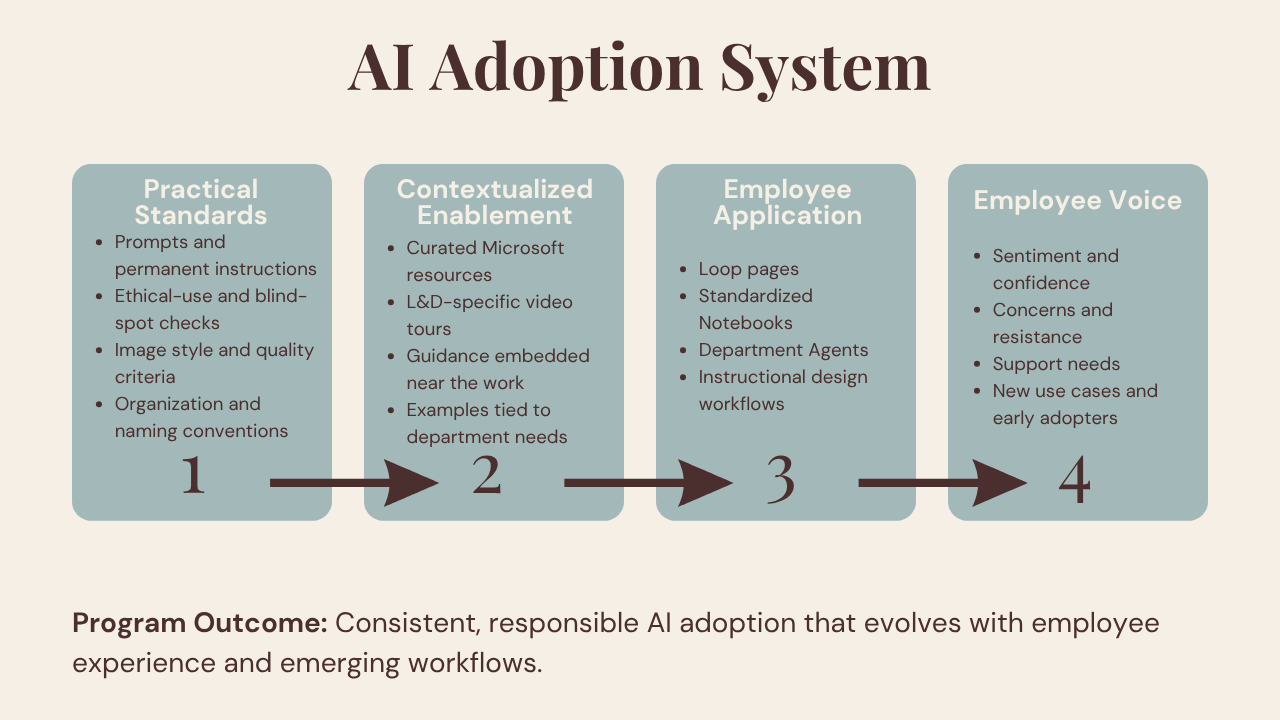
Developed practical standards for responsible, consistent AI use
Contextualized Copilot learning around department tools and workflows
Embedded employee listening, use-case discovery, and early-adopter identification into the rollout
This work connected learning design, performance support, governance, and change management rather than treating AI adoption as a one-time training event.
Key Deliverables
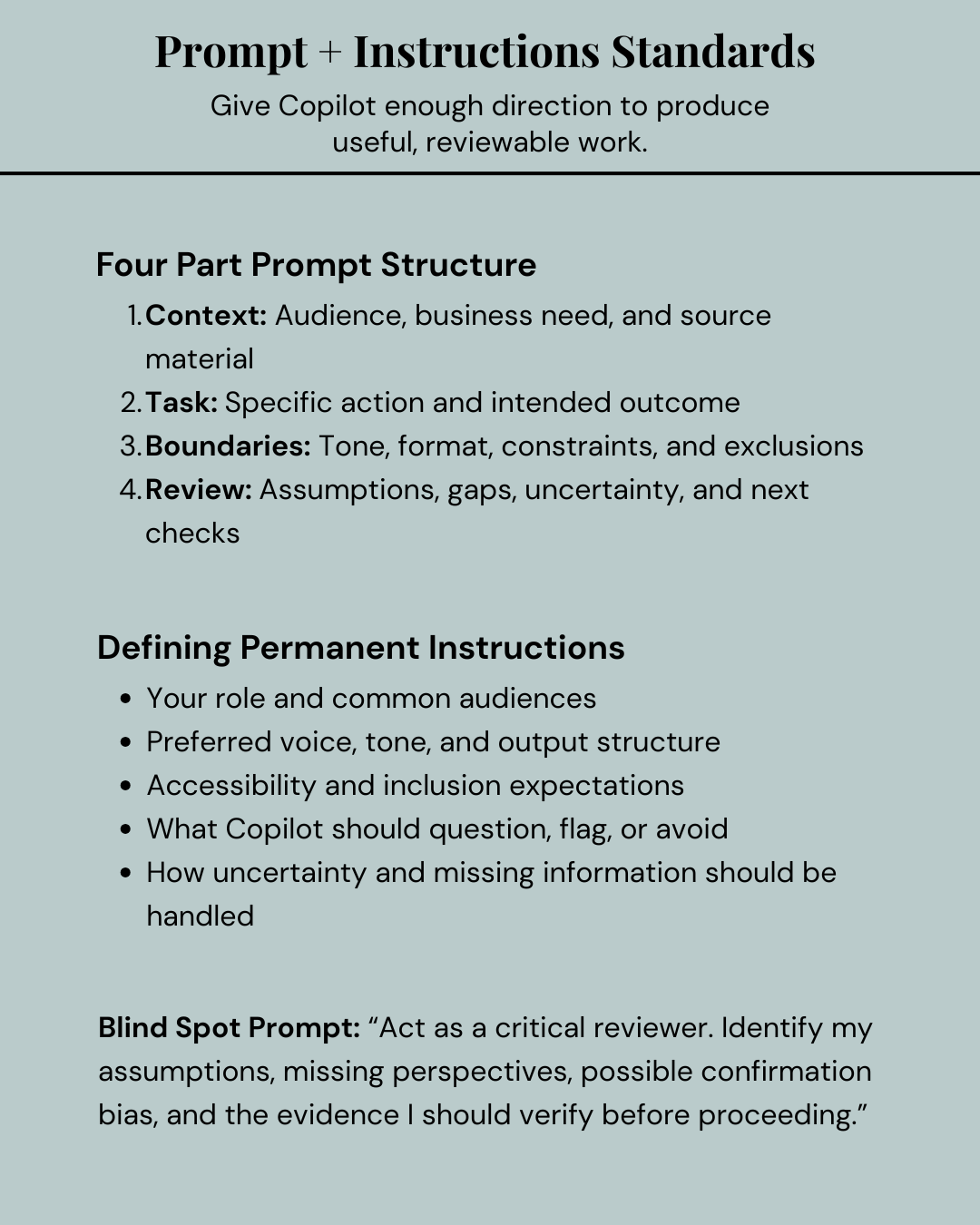
Prompt and Instruction Standards
Guidance for writing effective prompts, configuring permanent instructions, improving response quality, and prompting Copilot to challenge assumptions or surface alternative perspectives.
AI Image-Generation Style Guide
Department guidance for generating visual assets that align with established style expectations, along with examples of common AI-generation errors employees should identify before using an image.
Responsible-Use Guidance
Practical guidance addressing ethical use, confirmation bias, AI limitations, human review, and the employee’s responsibility for evaluating generated content.
Contextualized Copilot Resources
Curated Microsoft learning resources supplemented by department-specific tutorials covering the Loop pages, Notebooks, and Agents employees would use in their L&D workflows.
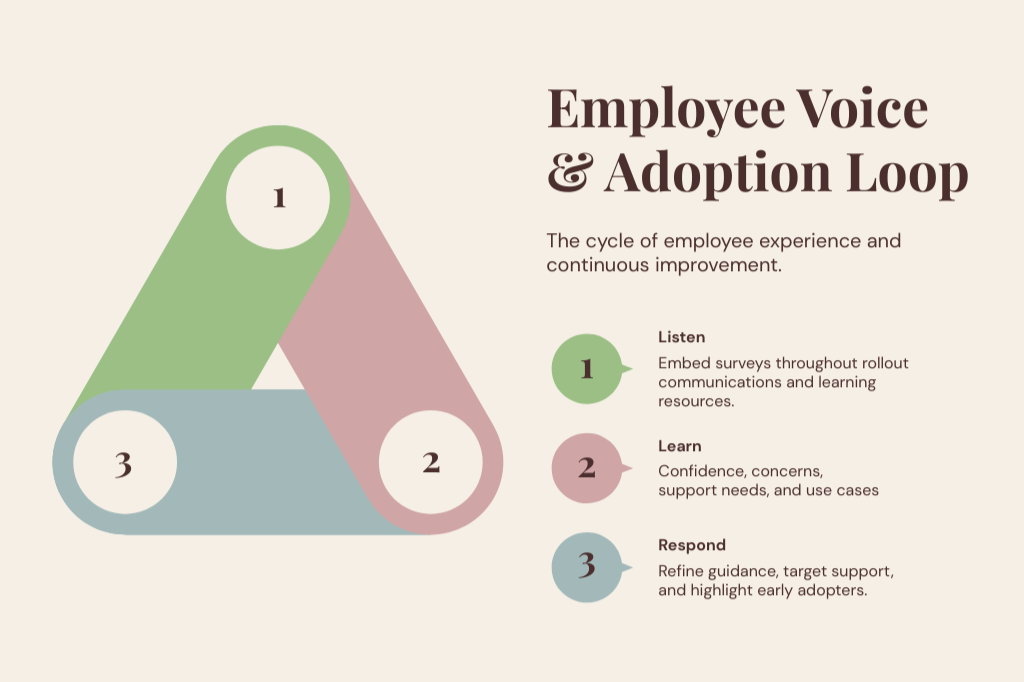
Adoption Surveys and Use-Case Discovery
Survey touchpoints designed to surface employee sentiment, concerns, resistance, support needs, emerging applications, and early adopters.
Strategy
Establish Practical Standards
I created shared guidance for how employees prompted Copilot, configured permanent instructions, organized AI-assisted work, generated visual assets, and evaluated responses.
The standards were designed to improve consistency while leaving room for employees to adapt AI to different projects and responsibilities.
Build Critical AI Judgment
The guidance addressed more than prompt construction. It helped employees recognize confirmation bias, incomplete reasoning, image-generation errors, ethical concerns, and other limitations that require active human review.
The goal was not unquestioning adoption. It was informed use supported by professional judgment.
Contextualize Learning Around Department Work
Rather than recreating Microsoft’s general product education, I combined existing Microsoft resources with targeted video tours and tutorials for the Loop pages, Notebooks, and Agents developed for the L&D department.
This connected foundational product knowledge to the specific tools, structures, and workflows employees would encounter in their work.
Listen and Adapt
I incorporated surveys throughout AI resources and rollout communications to understand employee sentiment, concerns, resistance, and support needs.
Employees could also share how they were already using AI. This created a mechanism for discovering new use cases, identifying early adopters, and using employee experience to shape future guidance.
Impact & Reflection
The initiative established a shared foundation for AI adoption and moved the department beyond disconnected experimentation.
The program:
Created greater consistency in prompting, instructions, organization, and visual generation
Made responsible-use expectations more practical and actionable
Connected general Copilot knowledge to department-specific workflows
Created a channel for employees to express concerns and influence future support
Surfaced employee-generated use cases that could inform continued enablement
Identified early adopters who could help demonstrate practical applications to their peers
Established an approach that could evolve alongside employee needs and the technology itself
Rather than positioning adoption as the completion of a training event, the initiative treated it as an ongoing cycle of standards, application, feedback, and refinement.
“The standards gave us a clear, practical starting point for using Copilot without taking away the flexibility to experiment. The surveys also made it clear that our questions, concerns, and ideas were part of the rollout.”
— L&D Team Member Survey Response