
Rise Onboarding - HarborPoint Launchpad
Instructional Designer & Learning Experience Lead | Onboarding Strategy | Performance Consulting | Stakeholder Partnership
The Challenge
HarborPoint Logistics Group was growing, but its onboarding experience had not grown with it.
New employees received very different introductions to the organization depending on their department and manager. Some were given only the information needed to begin working; others received large collections of documents and resources with little guidance about what mattered now, what could wait, or where to find information again later.
The result was an onboarding experience that created unnecessary uncertainty at exactly the moment employees needed clarity.
HR repeatedly answered common new-hire questions. Managers recreated onboarding materials and processes for their own teams. Important information could be buried among competing resources, while employees struggled to understand HarborPoint's systems, ways of working, support network, and expectations during their first few months.
The challenge was not simply to create an onboarding course.
It was to create a consistent organizational foundation without turning onboarding into a content dump or replacing the human experiences that help someone actually become part of a team.
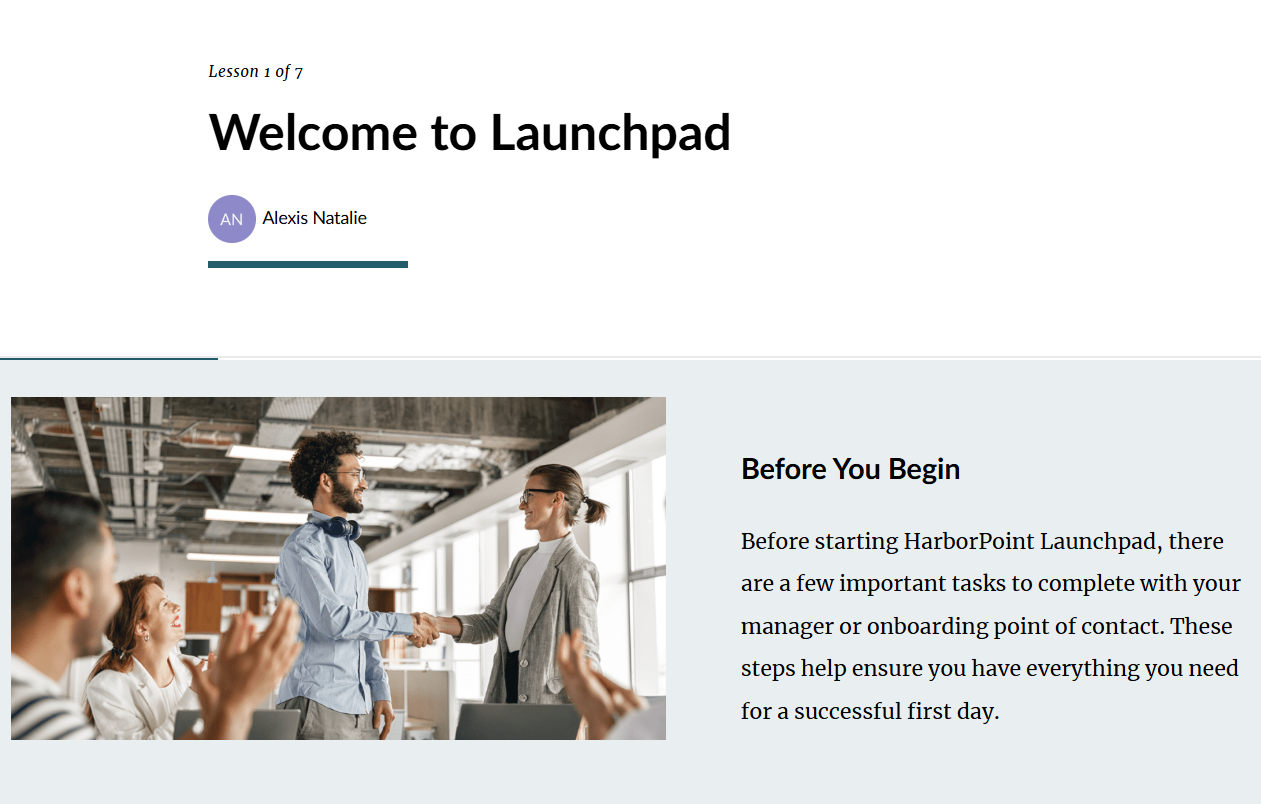
Discovery & Analysis
I began with an accelerated discovery process designed to reflect the inputs I would gather during an enterprise onboarding initiative.
The analysis considered perspectives across Human Resources, Operations, IT, Customer Success, and Warehouse leadership, alongside existing onboarding documentation, required training, new-hire feedback, recurring questions, and broader onboarding and turnover patterns.
Several themes emerged.
Employees needed a clearer understanding of:
who HarborPoint is and how the organization works;
what was expected of them during onboarding;
which systems and resources they would use;
where to go when they needed help;
what safety, security, and professional responsibilities applied across roles; and
what their first 90 days would actually look like.
The analysis also exposed a structural problem: more content would not solve an information-access problem.
Employees did not need another repository of everything HarborPoint knew. They needed enough information to orient themselves, make good decisions, and know where to return when a need arose.
That distinction became one of the primary design principles for Launchpad.
Rather than duplicating policies, compliance training, SOPs, or role-specific instruction, Launchpad would provide the universal context employees needed to navigate them.
Designing Within the Onboarding Ecosystem
One of the most important decisions came before building the course: Launchpad would not be onboarding.
I partnered with HR and leadership to define how the digital experience would fit within the broader onboarding journey they were building around it.
The resulting experience connected six stages:
Welcome & Setup → Required Compliance → HarborPoint Launchpad → Role-Specific Learning → Hands-On Experience → Ongoing Check-Ins
Launchpad established the shared organizational foundation, while managers and onboarding partners provided the experiences that could not—and should not—be replaced by eLearning: introductions, conversations, job shadowing, guided practice, feedback, relationship-building, and role-specific coaching.
This also changed the role of leadership.
Managers were not simply responsible for telling employees to “complete the course.” Leadership guidance was designed to help them pace Launchpad alongside real work, confirm equipment and system access, clarify role-specific expectations, connect employees with the right people, and hold meaningful check-ins as employees gained independence.
This approach allowed HarborPoint to standardize the foundation of onboarding while preserving the flexibility individual teams needed.
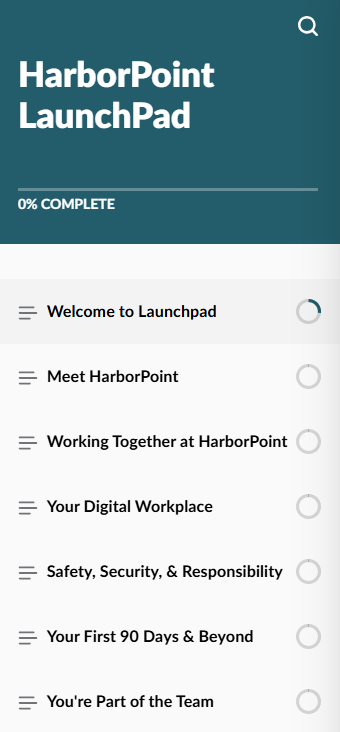
From Content Architecture to Learner Questions
The initial content architecture was broader and more fragmented. During iteration, I consolidated overlapping topics and reorganized the experience around the questions a new employee is actually trying to answer.
Instead of designing lessons around organizational categories, each lesson was given one primary learner question:
Welcome to Launchpad
What is happening today?
Meet HarborPoint
Who are we?
Working Together at HarborPoint
How do we work together?
Your Digital Workplace
What tools will I use?
Safety, Security & Responsibility
What responsibilities do I have?
Your First 90 Days and Beyond
What should I expect during my first few months?
Speak Up, Get Support & Find Resources
Where do I go when I need help?
Welcome to the Team
What does it mean to be part of HarborPoint?
This reframing gave me a simple test for every piece of content:
Does this help answer the learner's question?
If it did not, it could be moved, condensed, linked as a resource, or removed.
The resulting eight-lesson experience follows an intentional emotional progression as well as an informational one:
Reassurance → Understanding → Connection → Readiness → Confidence → Growth → Support → Belonging
That progression mattered because successful onboarding is not only knowledge transfer. New employees are also continually evaluating whether they understand what is happening, whether they can succeed here, and whether they belong.
Designing for Cognitive Load
Early content passes still felt too wordy and repetitive, even when the information itself was relevant.
That led to another round of editing.
Repeated welcome language was removed. Similar concepts were consolidated. Long passages were broken into shorter, purposeful blocks. Information that employees did not need to memorize was treated as performance support rather than instructional content.
I deliberately avoided converting source material page-for-page into Rise.
Instead, I asked what the learner needed to understand, do, decide, or locate.
This was particularly important for policies and resources. Launchpad teaches employees what a resource is for and when they may need it, while the source-of-truth resource remains outside the course. That reduces maintenance risk and prevents the onboarding experience from becoming another outdated copy of information maintained elsewhere.
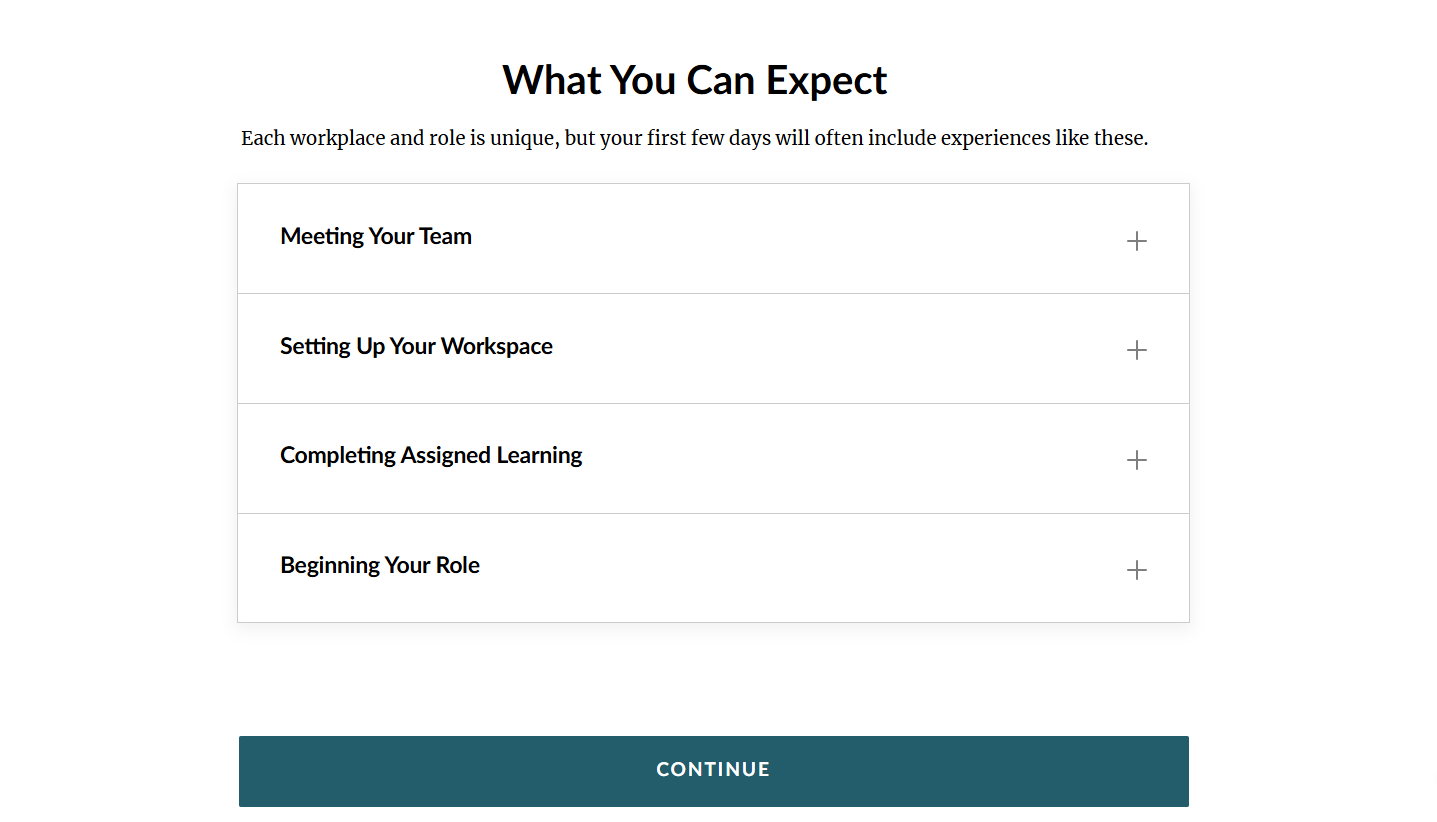
Designing for the Reality of Onboarding
Launchpad was designed as a resource employees could leave, return to, and use again, not a one-time memory test.
The experience supports saved progress and natural stopping points so managers can pace learning alongside the employee's actual onboarding schedule.
That decision is reflected most clearly in Your First 90 Days and Beyond.
Rather than presenting the first 90 days as a generic timeline, the lesson prepares employees for the experiences that actually build proficiency:
assigned learning, observation and job shadowing, hands-on practice, manager check-ins, relationship-building, questions, feedback, and gradually increasing independence.
The message shifts over time from:
“Here is what will happen during onboarding.”
to:
“You are becoming capable of directing your own continued growth.”
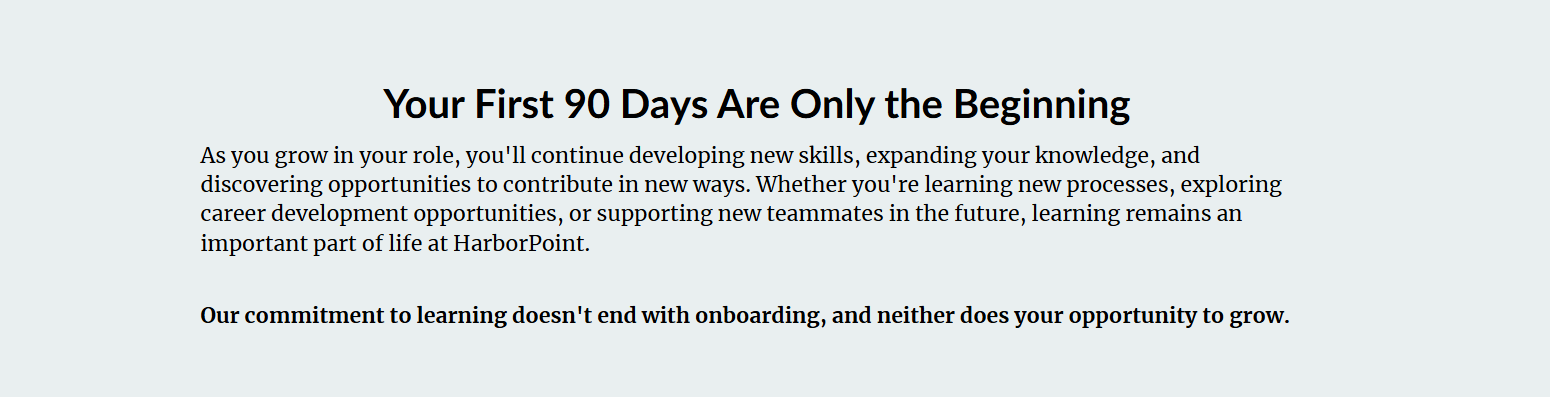
By the end of the lesson, development is no longer framed as something HarborPoint does to the employee. Learners are encouraged to seek feedback, build relationships, ask questions, practice deliberately, and continue learning beyond their formal onboarding period.
Interaction with Purpose
I intentionally resisted adding interaction simply to make the course appear more interactive.
Rise blocks were selected based on the job the content needed to do.
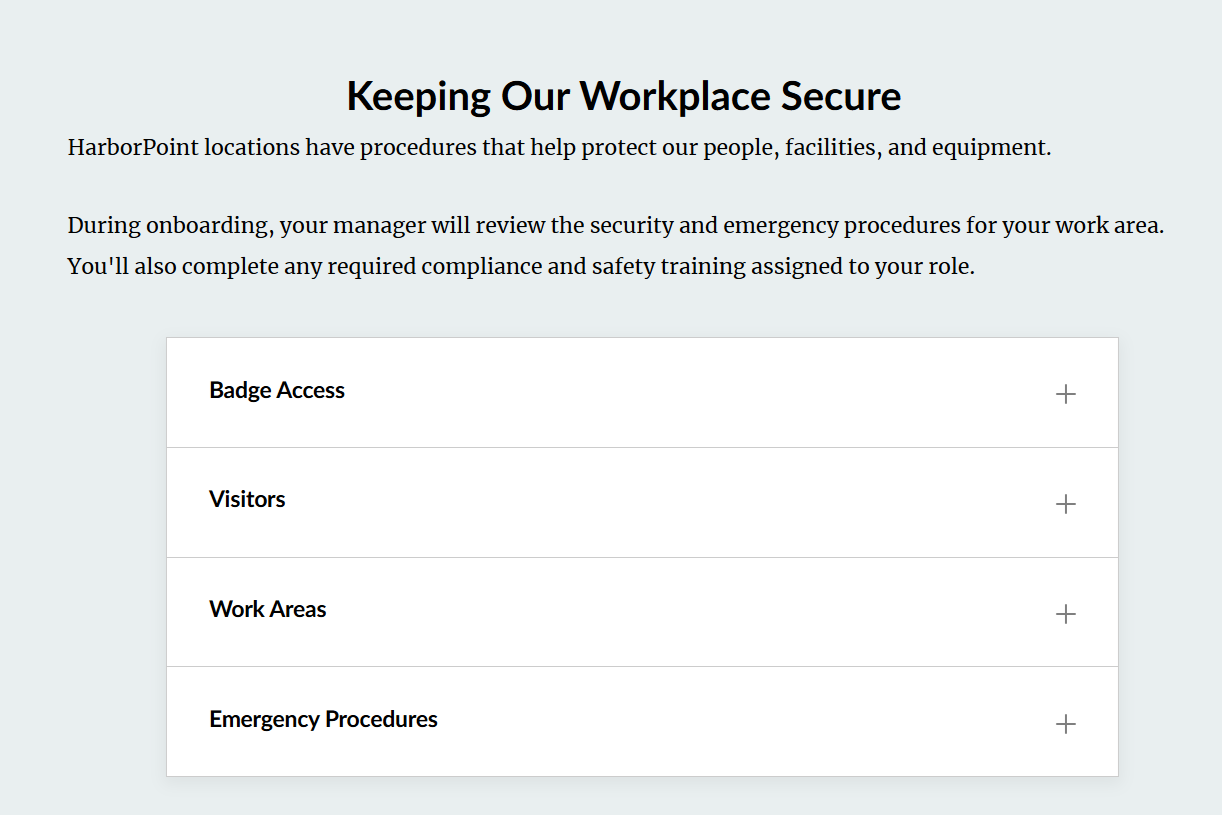
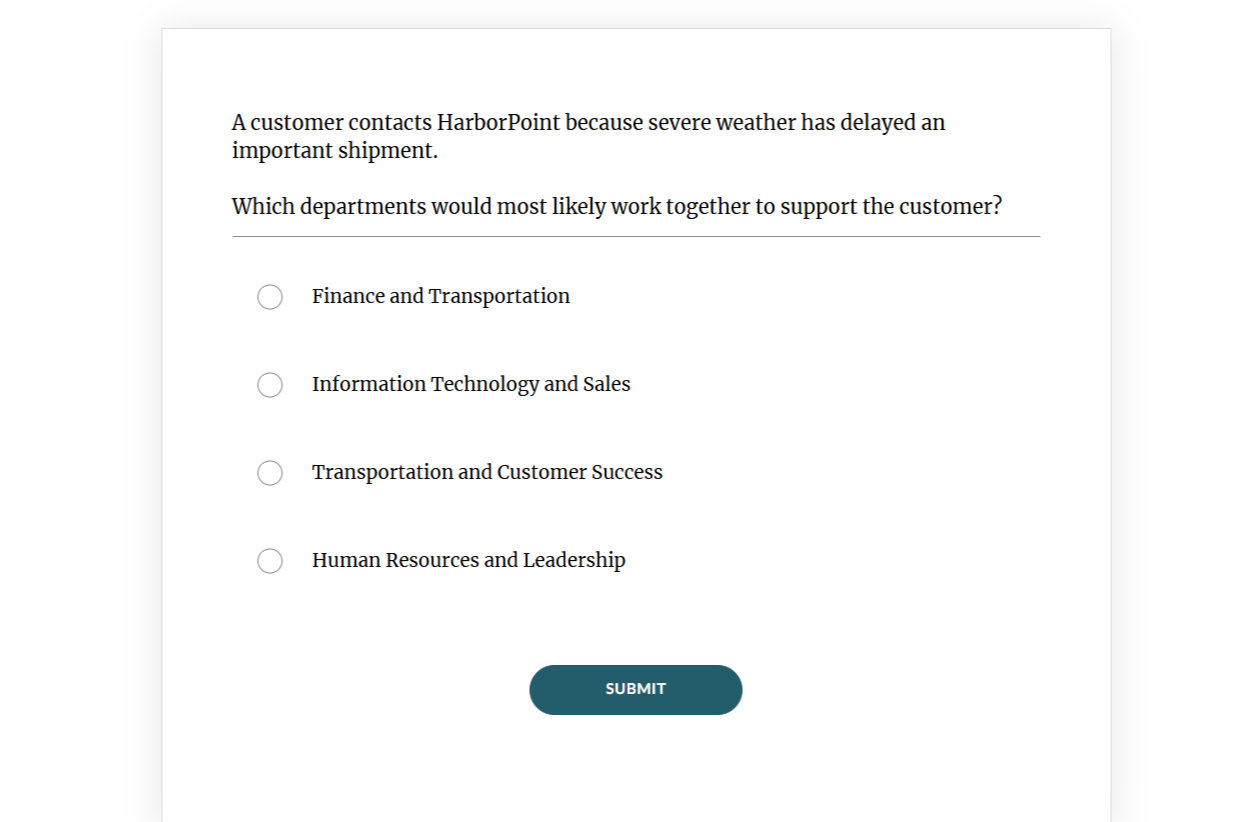
Processes and checklists communicate sequences and expectations. Accordions allow supporting information to remain available without overwhelming the page. Cards and grids make support networks and resources easier to scan. Knowledge checks focus on realistic decisions rather than trivia.
Where an interaction did not improve comprehension, decision-making, navigation, or practice, I used a simpler presentation.
The final experience therefore uses visual and interactive variety without forcing learners to click through content that could have been communicated more effectively in a few sentences.
Designing Beyond Rise
The learner-facing experience was supported by a separate Leadership Onboarding Guidance resource.
This companion deliverable translates the learning design into manager behavior: when to introduce different parts of Launchpad, what conversations should happen around them, what employees should experience outside the course, and where leadership judgment remains essential.
Together, the two deliverables solve different parts of the same performance problem.
Launchpad creates consistency.
Leadership creates context.
That distinction prevents a common onboarding failure: building an excellent digital experience and assuming that completing it automatically produces an excellent employee experience.
The Final Solution
The final solution is not simply an eight-lesson Rise course. It is a scalable onboarding framework built around three connected components:
HarborPoint Launchpad provides every employee with a consistent organizational foundation.
The onboarding journey positions that learning alongside compliance, role-specific instruction, hands-on experience, relationships, and ongoing manager support.
Leadership guidance helps managers turn the framework into an actual employee experience rather than a completion requirement.
Together, they address the original performance problems without attempting to solve them all through training.
New employees receive greater clarity about HarborPoint, their responsibilities, their first 90 days, and where to find support. Managers gain a repeatable structure without losing flexibility for their teams. HR has a common foundation to point employees toward instead of relying on disconnected materials and repeated explanations.
Most importantly, the design recognizes that onboarding has two jobs:
help someone become capable of working here, and help them begin to feel that they belong here.